
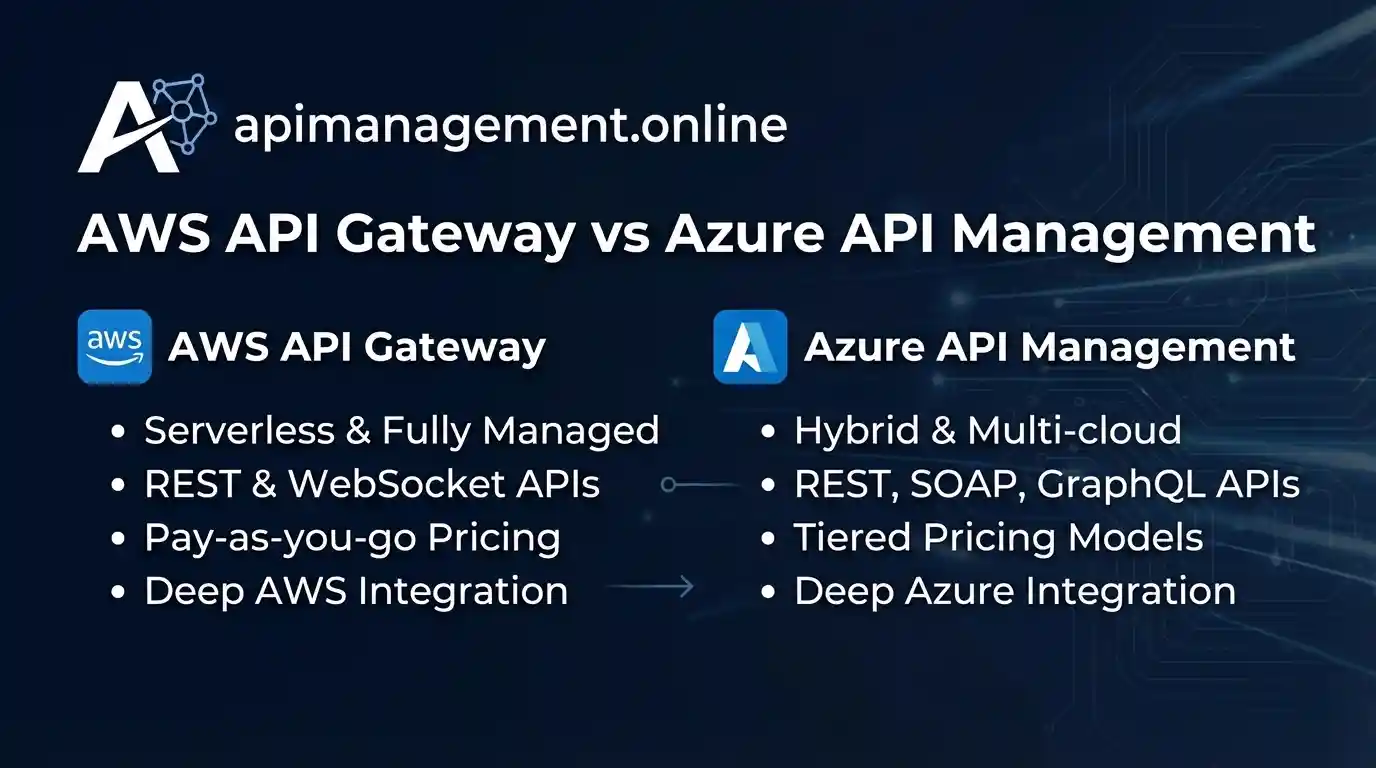
Deciding between AWS API Gateway vs Azure API Management (APIM) is a foundational choice for any organization committed to a cloud-native architecture in 2026. While both platforms offer highly resilient enterprise API gateways, they serve different strategic goals. AWS API Gateway is optimized for a serverless API approach with deep Lambda integration, whereas Azure APIM excels at full lifecycle API management, providing world-class developer portals and hybrid-cloud flexibility. In this definitive guide, we will analyze the technical trade-offs, security frameworks, and total cost of ownership to determine which cloud giant’s infrastructure wins for your specific enterprise needs.
In 2026, the complexity of managing digital endpoints has reached a fever pitch. APIs are no longer just technical utilities; they are the front door to your company’s digital business model. Whether you are scaling a microservices-based application or exposing B2B data to global partners, the infrastructure you choose must handle massive traffic spikes while enforcing zero-trust security policies without introducing crippling latency.
For most enterprises, the decision isn’t just about features; it is about ecosystem gravity. Organizations already deep in the AWS ecosystem often default to Amazon’s gateway, while those relying on Microsoft’s Entra ID (formerly Active Directory) and .NET services naturally lean toward Azure. However, as multi-cloud strategies become the norm, choosing a platform based purely on existing cloud spend is a mistake. We must look at the data plane (routing) and control plane (governance) performance separately.
Architectural Philosophies: Serverless vs. Governance
AWS API Gateway
Amazon’s offering is a pure-play serverless gateway. Its primary objective is to make it trivial to trigger serverless compute (Lambda) or other AWS services (DynamoDB, Kinesis) via HTTP. It is designed for developers who want to manage infrastructure-as-code and requires almost no operational overhead. It acts as a highly scalable, ephemeral entry point that thrives in high-volume, variable traffic scenarios.
Azure API Management
Microsoft’s platform is a full lifecycle governance suite. While it includes a powerful gateway, its real value lies in the “Manager” aspect. It is designed for organizations that need a formal API catalog, branded developer portals for partner onboarding, and complex policy-based transformations. APIM acts as a strategic facade over your entire backend, regardless of whether that backend is in Azure, on-premise, or in another cloud.
Security and Access Control in 2026
Both platforms have evolved to meet Zero-Trust security standards, but their implementation paths differ significantly.
AWS: IAM and Lambda Authorizers
AWS leverages its robust Identity and Access Management (IAM) system. You can secure endpoints using IAM roles or utilize Lambda Authorizers to execute custom authentication logic (e.g., checking a legacy token or validating a complex JWT). In 2026, AWS has streamlined its Cognito integration, but for many enterprise scenarios, developers still find themselves writing custom Lambda code to handle complex authorization scopes.
Azure: Policy-Driven Security
Azure APIM uses a no-code/low-code policy engine based on XML. You can enforce JWT validation, rate limiting, and mTLS by simply adding a policy snippet to the inbound processing layer. Its deep integration with Microsoft Entra ID (formerly Azure AD) is its “killer feature.” If your organization uses SSO for employees and partners, Azure APIM can enforce those same roles and permissions at the API level with zero custom code.
Performance: Edge Optimized vs. Hybrid
Where does the traffic actually flow? This is a critical question for latency-sensitive applications.
- AWS Edge-Optimized Endpoints: AWS can deploy your gateway at “Edge Locations” around the world (via CloudFront). This means a user in Tokyo hitting a gateway for a service in Virginia has their request enter the AWS private network as close to them as possible, drastically reducing total round-trip time.
- Azure Self-Hosted Gateways: Azure APIM offers a unique Self-Hosted Gateway option. This allows you to containerize the gateway and deploy it anywhere—even in your own on-premise data center or on AWS hardware—while still managing it from the Azure portal. This is a game-changer for hybrid-cloud and data residency requirements.
Round 3: Developer Experience and Portals
If you are trying to build an “API as a Product,” the Developer Portal is your most important asset.
Azure API Management wins this round convincingly. APIM includes a highly customizable, CMS-driven developer portal out-of-the-box. You can brand it to match your corporate identity, allow partners to sign up self-serve, and automatically generate interactive documentation from your OpenAPI Specifications. It even includes built-in support for multiple environments and subscription keys.
AWS API Gateway is more utilitarian. It provides a basic way to export your API as a Swagger file, but it does not have a “portal” in the traditional sense. Most AWS users either build their own custom frontend or utilize third-party tools like Postman or SwaggerHub to bridge the documentation gap for external developers.
Pro-Tip for 2026: If your APIs are strictly internal for microservices-to-microservices communication, the AWS approach is faster and cheaper. If your APIs are a product you sell to B2B partners, the Azure portal will save you months of development time.
Round 4: Pricing and TCO
Pricing is where these two giants diverge most sharply. AWS is transactional; Azure is tiered.
- AWS API Gateway: You are billed purely on usage (requests received and data transferred). There are no monthly “platform fees.” For low-volume startups or applications with unpredictable spikes, this pay-as-you-go model is nearly impossible to beat.
- Azure API Management: Azure offers several tiers: Consumption (Serverless), Basic, Standard, and Premium. The Consumption tier mimics the AWS model, but the higher tiers carry fixed monthly costs (ranging from $150 to over $2,800 per month). You pay for the governance, the portal, and the SLA, even if your traffic is low.
Our Commitment to Operational Transparency
At API Management Online, we pride ourselves on delivering technical insights that are free from vendor bias. Here is how we maintain our integrity:
- No Product Sales: We are strictly an educational and review blog. We do not sell cloud licenses, API gateways, or consulting services. We will never ask for your payment information or process transactions.
- Analytics Usage: We utilize Google Analytics to monitor aggregated traffic data. This helps us understand which cloud comparisons (like AWS vs Azure) are most helpful, allowing us to focus our research on what matters to you.
- Display Advertising: To keep our technical guides free and cover our server costs, we display programmatic ads via Google Ads. These third-party vendors use cookies to serve ads based on your digital footprint. You can opt out of personalized advertising at any time via your Google Ad Settings.
Need specific advice on your cloud migration? Reach out via our Contact Page.
Frequently Asked Questions (FAQ)
Can I manage AWS Lambda functions using Azure API Management?
Yes. Because Azure APIM acts as a proxy, you can set an AWS Lambda (exposed via an AWS Function URL or a Load Balancer) as the “Backend” in Azure. This allows you to use Azure’s superior developer portal while keeping your compute in AWS.
Which platform is better for WebSockets?
AWS API Gateway has a significant lead here. It offers native, highly scalable support for WebSockets that manages connections and state for you. Azure APIM supports WebSockets, but the implementation is more rigid and often requires more manual handling in the backend.
Does AWS API Gateway have an offline version for testing?
Yes. You can use LocalStack or the AWS SAM CLI to emulate the API Gateway environment on your local machine. Azure APIM does not have a native “offline” emulator, though you can use the self-hosted gateway container for testing.
What is the difference between REST APIs and HTTP APIs in AWS?
In AWS, “HTTP APIs” are a newer, lightweight, and up to 71% cheaper version of the gateway designed for low-latency routing to Lambda. “REST APIs” include more advanced features like edge-optimization, WAF integration, and complex request mapping templates.